Fire Extinguisher : 101

Wildfire Prevention Tips: Protect your Home and Property
This site was voted:

by onlinefiresciencedegree.org
(scroll to 74 on the list)
This article is intended to provide general information pertaining to wildfire prevention in order to help ensure the safety of homes and property in the event of a wildfire. |
Every year, countless wildfires take lives and leave people homeless. To increase our security and diminish the risk of disasters, we must better educate ourselves on the various causes and safety measures related to wildfires. Awareness will help us establish wildfire prevention in the future.
What causes wildfires?
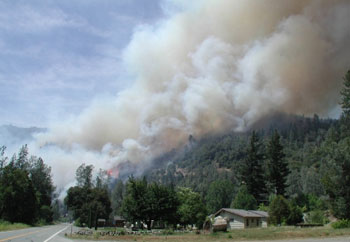 In general, wildfires are regarded as a natural phenomenon of the environment – nature’s way of eliminating dead vegetation – and although weather conditions play an important role in the event, seventy-five percent of wildfires are caused by people being careless.
Many assume that lightning and smoking are the most common causes of wildfires but both are in the minority of sources. Most wildfires are caused by individuals burning debris, vehicle exhaust, sparks from trains and heavy equipment, campfires, and yes, smoking and lightning, as well as arson.
Other causal factors:
- Climate. With global warming bringing about uncommon high temperatures and abnormal dryness, we are experiencing unusual environmental phenomena. Are there not more tornadoes, hurricanes, mudslides and floods than in the past?
- Topography. Land features such as lakes, rivers, swamps, hills and valleys can either accelerate or slow down wildfires. A blaze spreads faster uphill because of heat radiation and convection. The steepness of a hill also affects the speed of the spread: the greater the slope, the faster the spread.
- Vegetation. Plants or shrubs near your house, especially dry vegetation, can intensify and speed up a fire’s progress.
- Season and weather. Summer temperatures often break heat records, resulting in dry forests that present ideal conditions for wildfires.
- Geographical location. Some regions are more vulnerable to forest fires.
In the news, we hear of raging fires devastating larger and larger tracts of forests and land; in some tragic cases, they cause the destruction of entire neighbourhoods. Taking steps towards attaining wildfire protection is becoming increasingly more vital in protecting ourselves against grievous loss and damage caused by wildfires.
Fire-resistant materials
Homeowners living in rural areas should consider using fire-resistant materials in their houses. The roof is a home’s largest surface area potentially exposed to airborne sparks called firebrands, which pose the greatest threat. Should a wildfire draw near to your home, the roof of your house should be kept continuously wet in an effort to extinguish any firebrands that land on it.
The most fire-resistant roofing materials include metal, tile and fiberglass. Asphalt shingles and tarpaper also have certain fire resistant properties; however, because they are made of oil-based products, a significant level of heat can cause them to ignite. Of course, wood offers the least protection; a small spark can set fire to dry, sun-baked wooden shingles.
Walls and windows also play a determining role. Walls should be built with fire-resistant materials such as stone, brick or metal. Wood and vinyl offer the least protection. Windows allow radiant heat to pass through them and can, at times, set curtains ablaze. Large windows break more easily than small ones as they radiate more heat. Multi-pane windows give better protection from radiant heat than single-pane ones.
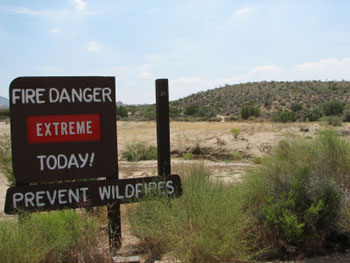 Firefighters
Homeowners who live outside major urban areas may be living in peaceful seclusion, but are also at a disadvantage with regard to fires. Because there are fewer firefighters in rural areas, country folk should be well-informed on wildfire prevention, and on how to protect their homes from fire risks and hazards. In order to rest assured, contact your local fire department – they would much rather help you prevent a fire than have to rush over to extinguish one.
In the event of an emergency, firefighters need to get to their destination quickly and safely. Clearly mark the entrance to your property with a sign indicating the house number, road name, and other helpful details. To ensure that the sign can be easily read from the main road, keep trees and bushes cut back so it remains visible.
Preparation for Battle
There are viable steps you can consider to protect your property against wildfires. Take safeguarding measures beforehand – do not wait to be surprised. When the blaze is raging, you cannot get close enough to work on the situation, and panic typically sets in. To take prior action against a wildfire gives you the upper hand. Below are some guidelines.
- Install smoke detectors or alarms in your house and test their function monthly. Replace the batteries regularly.
- Mount a functional fire extinguisher on every floor of your home, more importantly in the kitchen and garage, and know how to use it.
- Water your property occasionally so as to reduce the aridity, thereby reducing the chances for ignition. Decrease the sun’s heat on your lawn by creating shade.
- Create a defensible space. In order for fire to burn, it needs fuel, so build a safe perimeter around your house by eliminating combustible materials (width should be between 30 to 200 feet from the house). The wider the clearing and the fewer combustible debris, the greater the chance of protecting your home from a sweeping wildfire. Rake your property often to remove twigs, leaves, and dead plants. Homeowners with houses surrounded by thick vegetation should clear as much as 100 feet, and those with houses on slopes should clear as much as 200 feet.
- Design a tactical landscape by incorporating fire resistant plants in your yard. Not only will they cut down on the amount of mowing you have to do (for those who hate yard work) but they will also slow down a fire’s progress. By establishing a “greenbelt” of plants around your property, you introduce a fire barrier. Plants such as the California Redbud, the Monkeyflower, Sage and Common Yarrow are standard fire-resistant shrubs.
- Space your greenery as to create gaps because it makes it more difficult for a blaze to travel. Plant shrubs in 10 foot increments, and form larger gaps of 20 feet or more for trees. Trees like the Coast Live Oak and the California Sycamore are good choices for fire-resistant trees. Prune any bushes near your house to ensure that they do not become access routes for fire.
- Introduce rock, brick and concrete pathways through your lawn. Add bare soil into your landscaping pattern, as well as fir or redwood bark chips around plants as they prove hard to ignite and thus augment your wildfire protection.
- Inspect your roof because the air-borne embers of a wildfire can penetrate into inner roof cavities, especially those of houses in warm climates as they are not usually airtight compartments. Embers can be pushed inside the home by the heavy winds generated by a bushfire.
- Clean your gutters from dry leaves and debris and install steel gutter guards.
- Check your attic for light infiltration which would indicate a hole in the roof. Plug any gaps with fire-rated gap filler and spray a fire retardant substance on insulation material to prevent ignition.
- Cover all roof-mounted air conditioning units with a fire retardant cover.
- Check glass windows and doors. Fire can gain access into your house through windows and doors, and through the seals around them. Permanent protective screens are available, as well as shutters and external blinds.
You and the members of your household should know how to react in the event of a fire emergency. Develop a fire escape plan and practice it with your family regularly. The escape route should have at least two ground-floor exits.
Wildfire prevention is of the utmost importance if we wish to save our environment, our homes, and our lives. For more information on reducing the risk of wildfires, log on to: www.firewise.org.
Written by John Manley
Having experienced 2 house fires, John Manley now devotes some of his spare time educating people about the importance of having fire extinguishers, CO and fire alarms, and proper escape plans though the website: Fire Extinguisher: 101 - www.fire-extinguisher101.com.